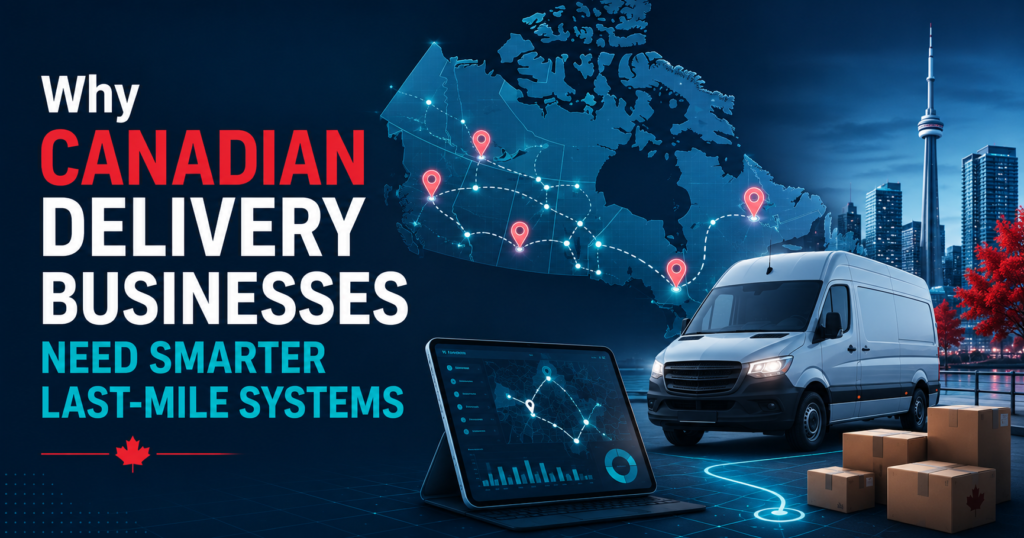
Last-mile delivery is the final movement of an order from a local distribution centre, warehouse, retail location, or delivery hub to the customer. Although it is the shortest stage of the delivery journey, it is often the most difficult to manage.
Canadian delivery businesses operate across crowded urban centres, expanding suburban communities, rural regions, and remote locations. A delivery model that performs well in downtown Toronto may not work effectively in northern Ontario, rural Alberta, or coastal British Columbia.
At the same time, customers expect accurate delivery estimates, real-time updates, flexible delivery options, and fast problem resolution. These expectations leave little room for manual planning, disconnected systems, or limited operational visibility.
Canadian retail e-commerce sales reached approximately $4.1 billion in September 2025 alone, representing 5.9% of total retail trade. Continued online purchasing means delivery businesses must manage greater order complexity while maintaining reliable service.
Smarter last-mile systems help delivery companies respond to these pressures by improving route planning, dispatching, driver coordination, customer communication, and delivery tracking.
Why Last-Mile Delivery Is Particularly Difficult in Canada
Canada’s size and geography create delivery challenges that are not equally present in smaller or more densely populated markets.
A single delivery business may need to serve:
- High-density neighbourhoods with limited parking
- Suburban communities spread across large areas
- Rural locations with long distances between stops
- Remote regions with limited road access
- Areas affected by snow, ice, flooding, or extreme temperatures
These conditions make fixed delivery plans unreliable. A route prepared early in the morning can quickly become inefficient when traffic increases, weather conditions change, a customer becomes unavailable, or a driver experiences a delay.
Transport Canada identifies chronic urban congestion, particularly around Toronto and Montréal, as a restriction affecting first-mile and last-mile connectivity.
Without technology that can respond to changing conditions, delivery teams must rely on phone calls, spreadsheets, messaging applications, and individual driver decisions. This makes it difficult to control costs or maintain consistent delivery performance.
Traditional Delivery Processes Cannot Handle Growing Complexity
Many delivery operations were originally designed for lower order volumes and simpler service expectations.
A dispatcher may manually assign orders based on postal codes or driver familiarity. Drivers may follow static routes and contact the office when something goes wrong. Customers may receive a broad delivery window but no meaningful update until the package arrives.
This approach becomes difficult to manage as the business grows.
More orders create more routes, drivers, customer requests, delivery windows, failed attempts, and exceptions. Manual processes do not simply require more effort. They also increase the risk of inconsistent decisions.
Common problems include:
- Drivers receiving unbalanced workloads
- Vehicles travelling unnecessary distances
- Orders being assigned to unsuitable routes
- Dispatchers discovering delays too late
- Customers repeatedly calling for updates
- Failed deliveries increasing operating costs
- Managers lacking accurate performance data
Smarter systems replace fragmented processes with a coordinated operational environment.
Smarter Route Planning Reduces Avoidable Mileage
Route planning involves more than arranging stops in the shortest geographical order.
An effective route must consider delivery windows, vehicle capacity, driver availability, traffic conditions, service time, road restrictions, order priority, and the starting location of each vehicle.
When routes are planned manually, it becomes difficult to evaluate all these factors together. Dispatchers may create routes that appear reasonable but result in unnecessary mileage, driver overtime, or late deliveries.
A smarter system can evaluate available operational data and build routes that are practical for real delivery conditions.
It can also adjust routes when:
- A priority order is added
- A driver becomes unavailable
- Traffic conditions change
- A customer updates the delivery time
- A road is closed
- A vehicle experiences a problem
- Weather disrupts part of the service area
Dynamic route adjustment helps delivery businesses maintain control even when the original plan is no longer workable.
Intelligent Dispatching Improves Driver Utilization
Dispatching directly affects how efficiently drivers and vehicles are used.
In a manual environment, the dispatcher must decide which driver should receive each order. That decision may depend on incomplete information or personal familiarity with the service area.
A smarter dispatch system can evaluate driver location, current workload, vehicle type, delivery priority, remaining capacity, and estimated completion time before assigning an order.
This reduces the risk of sending a driver across the city while another suitable driver is already nearby.
It also prevents certain drivers from becoming overloaded while others remain underused.
For growing delivery businesses, intelligent dispatching creates a more consistent process. Decisions are based on current operational information rather than assumptions or repeated phone calls.
Real-Time Visibility Helps Teams Manage Problems Earlier
Delivery businesses cannot manage what they cannot see.
When driver locations, delivery statuses, delays, and failed attempts are stored across separate tools, managers receive an incomplete view of daily operations.
A smarter system provides a shared dashboard where dispatchers and managers can see:
- Active drivers
- Current vehicle locations
- Orders in progress
- Completed deliveries
- Delayed stops
- Failed delivery attempts
- Routes falling behind schedule
- Unassigned orders
- Customer delivery changes
This visibility allows teams to respond before a small problem affects several deliveries.
For example, if one vehicle is running significantly behind schedule, the dispatcher can reassign nearby stops instead of waiting until customers begin complaining.
Real-time information changes delivery management from reactive problem-solving to proactive operational control.
Better Driver Tools Reduce Communication Gaps
Drivers are the people directly responsible for completing the final stage of delivery. However, many drivers still work with incomplete order information, printed instructions, calls from dispatchers, or disconnected navigation tools.
A driver application can provide everything required to complete the route in one place, including:
- Stop sequence
- Customer address
- Navigation support
- Delivery instructions
- Contact details
- Package information
- Proof-of-delivery capture
- Signature collection
- Photo upload
- Failed-delivery reason selection
- Updated instructions from dispatchers
Building these capabilities may require support from a mobile app development company that understands location tracking, offline access, secure data exchange, usability, and integration with existing delivery systems.
The objective is not simply to give drivers another application. The tool must reduce manual steps and make each delivery easier to complete correctly.
Accurate Delivery Estimates Improve Customer Trust
Customers are more likely to accept a delay when they receive clear and timely communication.
The larger problem occurs when customers receive an inaccurate delivery window, no update, and no explanation.
Smarter systems calculate estimated arrival times using current route progress rather than a fixed schedule created at the beginning of the day.
Customers can receive automatic notifications when:
- An order is dispatched
- The driver begins the route
- The delivery is approaching
- The expected arrival time changes
- The order has been delivered
- A delivery attempt is unsuccessful
This reduces uncertainty and lowers the number of “Where is my order?” calls handled by customer support teams.
Better communication also helps customers prepare for the delivery, which can reduce missed attempts and repeat trips.
Proof of Delivery Creates Clear Accountability
Delivery disputes are difficult to resolve when businesses have limited records of what happened at the customer location.
A smarter system allows drivers to capture digital proof at the point of delivery. This may include:
- Customer signatures
- Delivery photographs
- GPS coordinates
- Date and time stamps
- Recipient names
- Driver notes
- Barcode scans
- Failed-attempt evidence
These records help businesses respond to customer complaints, verify successful completion, and investigate recurring delivery issues.
Proof-of-delivery data is also valuable for business clients that need confirmation that their orders reached the correct recipient within the agreed service window.
Failed Deliveries Can Be Managed More Effectively
Failed deliveries create additional costs because the business may need to contact the customer, update the order, return the package, reschedule the stop, and send a driver again.
Not every failed attempt can be prevented, but smarter technology can reduce avoidable failures.
Customers can receive reminders before the driver arrives. They may also be able to update instructions, select a safer location, request contactless delivery, or reschedule within approved time windows.
When a delivery still cannot be completed, the driver can record a standardised reason. The system can then initiate the correct next step without requiring several manual actions.
Over time, businesses can analyse failure data to identify patterns such as the following:
- Incorrect addresses
- Repeated absence in specific delivery windows
- Difficult building access
- Incomplete customer instructions
- Service areas with high failure rates
- Orders requiring special handling
This information supports better planning and more realistic delivery policies.
Smarter Systems Help Control Delivery Costs
Last-mile costs are affected by fuel usage, driver hours, vehicle utilisation, route efficiency, failed attempts, customer support activity, and administrative work.
When these areas are managed separately, businesses may know their total delivery expenses but not understand which operational problems are increasing them.
A smarter system connects cost-related information with delivery activity.
Managers can compare:
- Planned mileage against actual mileage
- Estimated route time against completion time
- Cost per stop
- Deliveries completed per driver
- Failed-attempt rates
- Overtime by route
- Vehicle utilization
- Average service time
- Delivery performance by region
This allows businesses to identify whether costs are being driven by poor route design, unsuitable service windows, repeated failures, low vehicle utilization, or inefficient delivery areas.
The goal is not to reduce spending blindly. It is to remove avoidable costs without weakening service quality.
Data Helps Managers Improve Future Operations
Daily delivery data becomes valuable when it is converted into useful operational insights.
Instead of relying on general impressions, managers can see which routes are consistently delayed, which areas generate the most failed deliveries, and which delivery windows are difficult to achieve.
Important performance indicators may include:
- On-time delivery rate
- First-attempt success rate
- Average cost per delivery
- Average distance per stop
- Orders completed per route
- Customer notification success
- Driver idle time
- Route completion variance
- Delivery exception frequency
These insights support decisions about staffing, service areas, pricing, fleet requirements, customer commitments, and expansion.
For example, if a particular region repeatedly creates high mileage and low delivery density, the company can reconsider its delivery schedule, minimum order value, service fee, or local hub strategy.
Smarter Technology Supports Canadian Weather Disruptions
Canadian weather can change delivery conditions quickly.
Snowfall, icy roads, heavy rain, flooding, wildfire activity, and extreme temperatures can affect route safety and delivery speed. Businesses using fixed schedules may struggle to update every affected route manually.
A smarter system can help teams identify delayed routes, communicate revised arrival times, prioritize urgent orders, and reassign stops where possible.
Historical delivery data can also help businesses prepare seasonal plans.
A company may learn that certain regions require additional route time during winter, that specific vehicles perform better in difficult conditions, or that customer availability changes during severe weather.
Technology cannot remove weather risk, but it can help businesses make faster and better-informed decisions when conditions become unpredictable.
Connected Systems Prevent Duplicate Work
A delivery operation may depend on e-commerce platforms, warehouse software, order management tools, customer relationship systems, accounting software, and driver applications.
When these systems do not communicate, employees may need to enter the same information several times.
This creates delays and increases the risk of incorrect addresses, missing instructions, duplicate orders, and outdated delivery statuses.
A connected system can automatically transfer order information from the sales or warehouse platform into the delivery workflow.
Once the delivery is completed, the status can be sent back to the relevant business systems.
This creates a continuous information flow from order creation to final confirmation.
Integration is especially important for businesses managing a large number of daily orders or serving multiple retail, healthcare, food, wholesale, or e-commerce clients.
Scalable Systems Make Business Growth Easier to Manage
A delivery process that works for 100 orders per day may become unstable at 500 or 1,000 orders.
Without scalable technology, growth often requires more dispatchers, more manual coordination, and more administrative work.
A smarter system allows businesses to expand routes, vehicles, drivers, service regions, and customer accounts without increasing operational complexity at the same rate.
It can also support different delivery models, such as:
- Same-day delivery
- Scheduled delivery
- Multi-stop distribution
- Business-to-business delivery
- Contactless delivery
- Temperature-sensitive delivery
- Returns and reverse logistics
- Local retail fulfilment
Scalability does not mean adding unnecessary features. It means building a system that can support greater volume and new service requirements without disrupting current operations.
What Canadian Delivery Businesses Should Look for in a Smarter System
The right technology should reflect the company’s delivery model rather than forcing the business into a generic process.
Important capabilities include:
Dynamic Route Planning
The system should create and update routes based on real operational constraints.
Intelligent Order Assignment
Orders should be allocated using driver location, availability, capacity, priority, and vehicle suitability.
Live Driver Tracking
Dispatchers should be able to see route progress without repeatedly contacting drivers.
Automated Customer Notifications
Customers should receive timely updates throughout the delivery process.
Digital Proof of Delivery
Drivers should be able to capture signatures, photographs, time stamps, and delivery notes.
Exception Management
The system should clearly identify delays, failed attempts, unassigned orders, and other delivery problems.
Operational Reporting
Managers should be able to measure delivery performance, costs, route efficiency, and customer service outcomes.
System Integration
Delivery workflows should connect with the company’s existing order, warehouse, retail, accounting, or customer platforms.
Driver-Friendly Design
The driver interface should be simple, fast, and practical for use throughout the working day.
When Custom Development Becomes Necessary
Off-the-shelf delivery software may work for businesses with standard workflows and limited integration needs.
However, custom development may be more appropriate when the business has:
- Unique dispatching rules
- Multiple delivery service types
- Existing legacy systems
- Industry-specific compliance requirements
- Complex client reporting needs
- Special vehicle or package requirements
- Regional pricing structures
- Custom driver workflows
- Large integration requirements
- Plans to offer delivery technology to external clients
Custom development allows the technology to support the actual business model instead of requiring teams to work around software limitations.
The decision should be based on operational requirements, future growth, integration needs, and the total cost of continuing with inefficient processes.
Conclusion
Canadian delivery businesses face a combination of large service areas, urban congestion, unpredictable weather, rising customer expectations, and growing order complexity. Manual route planning and disconnected tools make these pressures harder to manage.
Smarter systems help businesses coordinate routes, drivers, vehicles, customers, and delivery data through a single operational environment. They improve visibility, reduce avoidable mileage, strengthen communication, and provide the information managers need to control performance.
For companies that have outgrown spreadsheets, static routes, or disconnected applications, integrating supply chain management software with a last-mile delivery management solution can create a reliable and scalable foundation for managing delivery operations across Canada.