
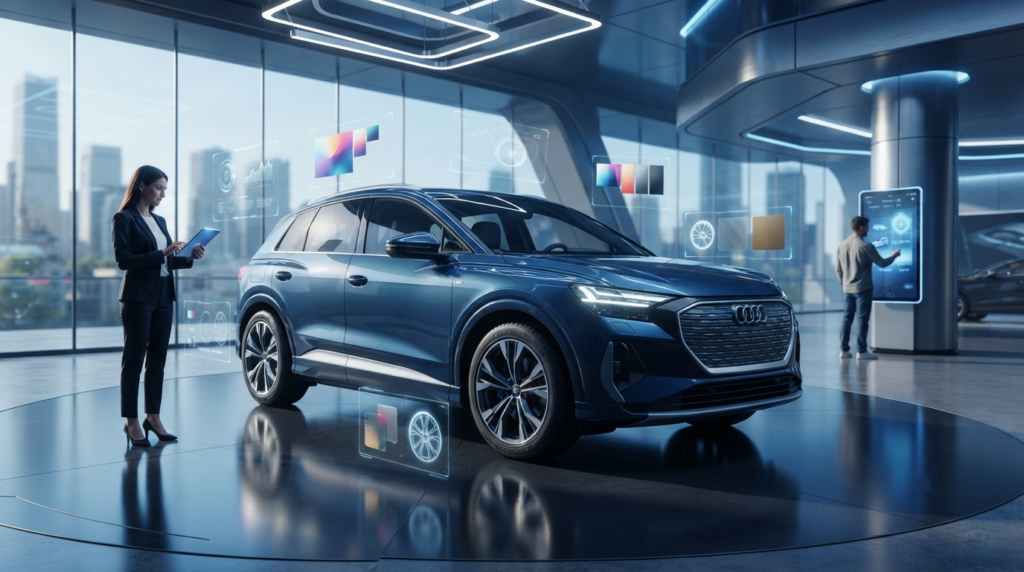
Car buying used to mean flipping through a glossy brochure, walking a dealership lot under fluorescent lights, and hoping the salesperson had the exact trim and color combination you wanted sitting somewhere in the back lot. That world is fading fast. Today’s car shoppers spend most of their decision-making time online, long before they ever set foot near a dealership, and what they find on a brand’s website often shapes whether they show up at all.
This shift is exactly why 3D visualization has become such a big deal in the automotive industry. It’s no longer a novelty reserved for auto shows or concept reveals. It’s showing up on product pages, in configurators, inside sales apps, and even in showroom kiosks, quietly changing how people shop for cars. Let’s look at why that’s happening and how automotive companies are actually putting it to work.
Why Static Images Aren’t Cutting It Anymore
For years, car websites relied on photography. A few dozen images per model, maybe a 360-degree spin captured from a studio shoot, and that was considered thorough. The problem is that photography is expensive to produce at scale and painfully inflexible once it’s live. Add a new color, a new wheel option, or a new trim package, and you’re back in the studio scheduling another shoot.
Buyers also don’t experience a car in isolation. They want to see how a specific color looks with a specific wheel set, under different lighting, from angles a photographer never bothered to capture. Static images simply can’t keep up with that level of curiosity, and shoppers notice when a website feels limited compared to what they can do in a showroom.
3D visualization solves this by replacing fixed photography with a live, renderable model. Instead of storing thousands of pre-shot images, brands store one detailed 3D asset that can be rendered in any color, trim, or configuration on demand. That single shift changes almost everything downstream, from how fast a site can update to how deeply a shopper can explore before ever contacting a dealer.
Interactive Configurators as the New Test Drive
The most visible use of 3D visualization in automotive is the configurator. Nearly every major manufacturer now offers some version of a build-and-price tool where shoppers pick a trim, choose exterior and interior colors, add packages, and watch the vehicle update in real time on screen.
What makes this powerful isn’t just the visual polish. It’s the psychological effect of ownership. When someone spends ten minutes customizing a vehicle to their exact taste, they form an emotional connection to that specific configuration. Marketing researchers have long understood that people value things more once they’ve had a hand in creating them, and configurators tap directly into that instinct. A shopper who has built “their” car in a configurator is far more likely to follow through with an inquiry than one who scrolled past a static gallery.
Configurators also collect valuable signals along the way. Every color selected, every package added, and every angle viewed tells a brand something about buyer intent, which can then inform retargeting, inventory planning, and even production forecasting. The tool isn’t just engaging shoppers; it’s quietly feeding data back into the business.
Bringing the Showroom to the Living Room
Dealership visits have declined for years, and that trend accelerated further as more of the buying journey moved online. Automotive companies have responded by trying to recreate as much of the in-person experience as possible on the web.
3D visualization makes this genuinely possible in a way photography never could. Shoppers can rotate a vehicle a full 360 degrees, zoom into stitching on the seats, open a virtual door, or look underneath at the chassis. Some experiences let users adjust lighting to see how a paint color shifts from daylight to dusk, which matters a great deal for buyers agonizing over a color choice. Interior walkthroughs let people sit “inside” the cabin virtually, checking sightlines, dashboard layout, and legroom before committing to a test drive.
This matters even more for buyers who live far from a dealership carrying the trim or color they want. A rural shopper interested in a specific configuration might be hours from the nearest dealer that has it in stock. A rich 3D experience lets them evaluate that exact configuration from home, closing the gap between curiosity and confidence without needing a physical unit nearby.
Reducing Friction at the Point of Decision
One of the quieter benefits of 3D visualization is how it reduces hesitation. Buying a vehicle is a significant financial decision, and uncertainty is one of the biggest reasons shoppers delay or abandon the process. If someone can’t picture exactly what they’re getting, they’re more likely to second-guess themselves or shop around indefinitely.
Detailed 3D visualization removes a lot of that ambiguity. When a buyer can see the precise combination of trim, color, and accessories rendered accurately, there’s less mental gap between “browsing” and “deciding.” Some brands have layered augmented reality on top of 3D models, letting shoppers place a life-size virtual version of a vehicle in their own driveway using a smartphone camera. Seeing a car “parked” outside your actual house is a different kind of persuasion than seeing it on a showroom floor, because it removes the last bit of imagination required to picture ownership.
This reduction in friction shows up in measurable ways too. Dealerships and manufacturers that have implemented rich configurators and 3D showroom tools frequently report longer time-on-site, more saved configurations, and higher rates of dealer inquiries compared to sites relying purely on static photography. Engagement metrics like these matter not just for vanity, but because they correlate closely with purchase intent.
Supporting Sales Teams, Not Just Shoppers
It’s easy to think of 3D visualization purely as a customer-facing tool, but it’s increasingly used internally as well. Sales staff at dealerships are trained to walk customers through configurators on tablets, especially when the specific trim or color a customer wants isn’t physically on the lot. Instead of apologizing for the gap in inventory, a salesperson can pull up an accurate, fully interactive model right there in the showroom.
This also helps standardize the sales conversation. Every rep, regardless of experience level, has access to the same polished visual tool, which levels the playing field between a seasoned salesperson and someone newer to the floor. It also speeds up training, since new staff can learn vehicle features by exploring the 3D model themselves rather than memorizing spec sheets.
Manufacturers benefit too. Marketing teams can preview upcoming model years or limited editions internally using 3D assets long before physical units exist, allowing campaigns, dealership materials, and press previews to be built well ahead of a vehicle’s actual production run.
The Growing Role of Real-Time Rendering
Early 3D automotive experiences relied on pre-rendered images stitched together to simulate interactivity, which limited how much customization was actually possible. The technology has moved well past that. Real-time rendering engines, similar to what’s used in high-end video games, now allow automotive 3D tools to generate lighting, reflections, and material textures on the fly, based on whatever combination a shopper selects.
This has a few practical effects. First, it makes near-infinite customization possible without ballooning production costs, since new combinations don’t require new photography or manual rendering work. Second, it makes experiences feel more responsive and lifelike, with paint that genuinely reflects light the way it would in person and materials like leather or brushed metal that look convincingly tactile on screen. Third, it opens the door to features like live day-to-night lighting transitions or weather previews, letting shoppers see how a vehicle might look parked outside on a rainy evening versus a sunny afternoon.
As rendering technology becomes more accessible and less computationally expensive, expect these experiences to keep expanding beyond configurators into areas like virtual test drives and fully explorable digital showrooms accessible from any browser, no special hardware required.
What This Means for the Road Ahead
The automotive industry has always sold more than transportation. It sells identity, aspiration, and a sense of who a buyer wants to be behind the wheel. 3D visualization gives brands a far more powerful tool to communicate that emotional value than photography ever could, because it puts the shopper in control of the experience rather than asking them to imagine it from a fixed set of images.
As buyer expectations continue to shift toward richer digital experiences before any in-person interaction, the gap will likely widen between brands that invest in interactive, high-fidelity 3D tools and those that still rely on static catalogs. For an industry built on emotional connection to a product, giving shoppers the ability to see, customize, and almost touch a vehicle from anywhere isn’t just a nice-to-have feature anymore. It’s quickly becoming the baseline expectation for how people shop for cars.